

Saunas that follow the Scandinavian model of being a community hub have rolled out with rapid pace. In London, there’s Arc in Canary Wharf, an upmarket contrast therapy club which caters predominantly to the finance crowd. In Manhattan, Othership, Lore Bathing Club and The Altar have followed the popularity of Bathhouse. In 2026, social sweat is mainstream, and can be found in rural locales. Today, they’re as common a meeting place as a cafe.
Beyond is an insight and strategy company shaping the future of sport and culture. In our fieldwork around the world, we're watching budget gyms close the gap on luxury - and premium fitness clubs struggle to justify their price tag. In this piece, we reveal why the luxury gym's traditional value proposition is eroding, and what a new era of fitness hospitality needs to look like to survive.
The popularity of ‘bathing’ has trickled down into other spaces. Many boutique Pilates studios now have saunas as an add-on amenity: here, the sauna is convenient, and the clubs offer regulars a sense of locality. Budgets gyms are also incorporating saunas. In Liverpool, UK, Frasers Group unveiled its all-new Sports Direct superstore, equipped with an Everlast Gym. Members get access to a state-of-the-art Hyrox training zone, a reformer Pilates studio, and a contrast therapy suite, containing multiple infrared saunas and cold plunge pools. It costs £35 a month.
Suddenly, the prices commanded for Equinox ($400+ per month at Hudson Yards in Manhattan) and Third Space (£325/$450) suddenly seem harder for customers to justify.
Spaces such as Equinox in the U.S. and Third Space in London were once seen as a benchmark for high-end fitness, but increasingly, its customers are stacking alternate memberships, such as at padel, tennis, Pilates or contrast therapy clubs. Customers have more choice and are more discerning than ever; suddenly, the ‘one stop shop’ sell of Equinox and Third Space no longer feels applicable. Amid this hollowing out of the market, where does this leave upscale gyms?
The turning point of fitness hospitality
They need to redefine their value proposition. Typically, luxury gyms’ value was in its distinct version of high-end hospitality. Think: a schedule-rich selection of classes; a coffee and protein counter; premium shower facilities with fluffy towels and GHDs; a sauna. Now, these touchpoints are de rigueur. Within Everlast gyms, members receive all these amenities. Frasers Group chief executive Michael Murray notes that the strategy behind Everlast is to make the luxury experience more accessible.
Suddenly, the prices commanded for Equinox ($400+ per month at Hudson Yards in Manhattan) and Third Space (£325/$450) suddenly seem harder for customers to justify. We visited the Boulder branch of Lifetime on a $100 day pass recently, and were underwhelmed by the offering. “This gym is NOT worth the money,” posted one disgruntled former employee on the Equinox reddit thread in February; the company is in the middle of a huge U.S. rollout, with more than 20 new sites slated across the country. “People pay several thousand a year for what? The gym is essentially the same as LA Fitness, minus the crowd. The spa itself is not even complimentary.”
Businesses within this sector need to redefine what fitness hospitality is. The sauna and stream room are no longer special, and members today want more.
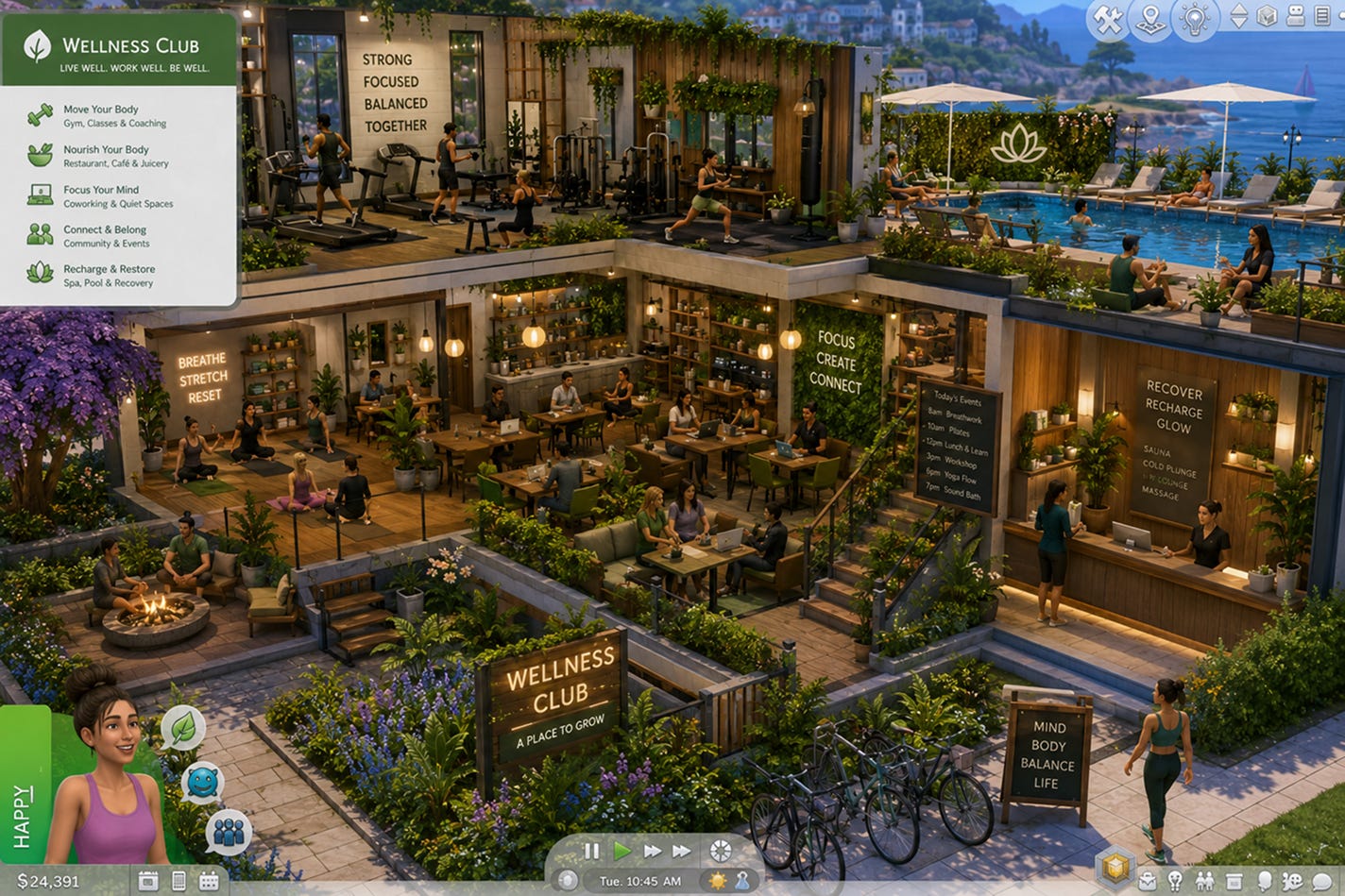
For the first time, upscale gyms are facing competition from the bottom end of the market. But, amid the rise of luxury wellness clubs, they are also competing against the top end. Heimat, a members-only concept fitness club in Los Angeles, is a prime example. Costing $350 a month, it’s more affordable than Equinox Hudson Yards, but what you get is a combination of the best fitness hospitality, plus concepts borrowed from hotels and the food and beverage industry. There’s a gym and a robust class programme, but more compelling is the Michelin-star restaurant, a rooftop pool, spa facilities offering IV infusions and, crucially, a coworking club where members can stay all day to take meetings or socialise. At Animo, a ‘social wellness and performance club’ in Brussels, the all-day restaurant and cafe is filled with members working on laptops.
Here, fitness and well-being become part of a members’ life. It represents true value, not only for the fitness offerings but because ultimately, the space is designed for people to spend time. In this freelance or work-remote economy, luxury wellness clubs make economic sense. Time is money, and they cut down on commutes to free up time for movement—they also stop members needing to rent a separate workspace and offer an on-demand community of like-minded individuals. (Health Clubs like Soho House have pivoted from hedonism to wellness to cater to this growing lifestyle and maintain relevance: its members were drinking less, and spending less money across the bar.)
In this freelance or work-remote economy, luxury wellness clubs make economic sense.
With the exception of the Hudson Yards branch, most Equinox branches have an armchair or two in the foyer; Third Space has a couple of chairs at its coffee counters. Those spaces are not designed for loitering, let alone leisure. Looking to take a work Zoom there? Forget it. Modern, mainstream gym hospitality needs to evolve. At Animo, the menu offers chef-prepared meals that are cooked fresh to order; smoothies and protein shakes arrive in refined glassware, and coffee comes in handcrafted ceramics. Working from the gym is a selling point, not a compromise; Animo has fine-tuned its hospitality thoughtfully to truly meet its members where they are at.
Businesses within this sector need to expand their horizons. They need to redefine what fitness hospitality is. The sauna and stream room are no longer special, and members today want more. Currently, the new status symbol within luxury gyms and wellness clubs is red light therapy and hyperbaric oxygen chambers: a more comprehensive longevity offer that includes biohacking will become increasingly relevant.
Where do we go from here?
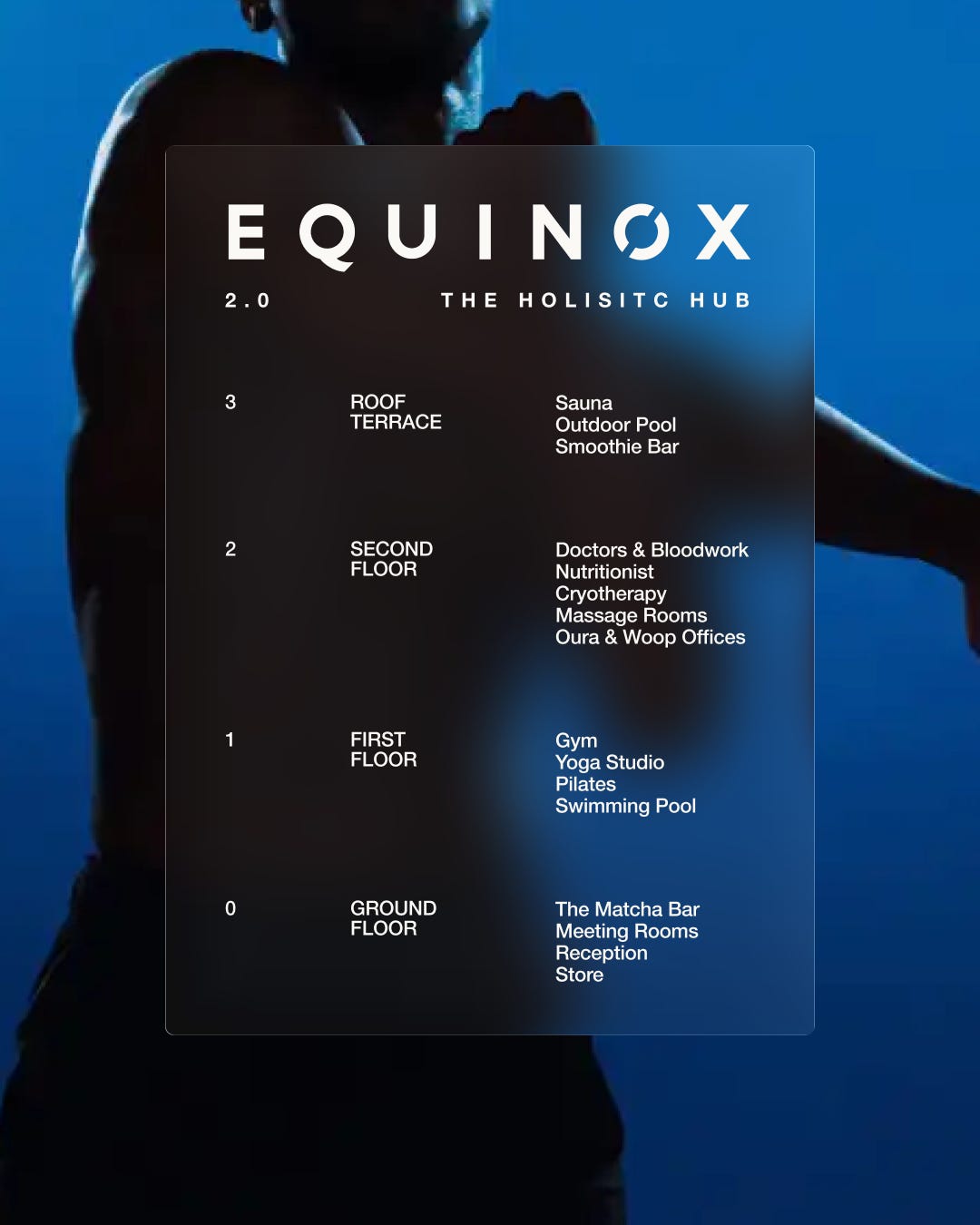
We’re predicting the rise of more direct health integrations. Luxury health clubs will start to offer medical services. Bloodwork, GLP-1 prescriptions, peptides, food sensitivity tests; women’s hormones tracking; access to nutritionists. The proposition will be a data-backed holistic hub for all your health and wellbeing needs; gyms will combine services offered by Voy and Thriva in-house, combined with personal data from Oura and Whoop, to offer a comprehensive service. Comprehensive health scans could also be included. It will be a one-stop-shop for optimisation and personal care.
Businesses outside of the typical gym sector should pay attention. Do you share a customer base with luxury gyms? If so, how could your business partner with them to offer an experiential service? Think of innovative ways of removing the friction from people’s daily life to ensure they can find time to prioritise movement. Are you a childcare provider who could open a creche within a gym? Are you a beauty therapist who could offer waxing? Most luxury gyms have a spa, where a massage is the hero experience. But for most, a massage is a luxury yet a bikini wax is essential—especially when the sauna is a social play.
Are you a sports brand who could offer a curated offering in a boutique? Are you a supplements brand who could partner on protein shakes or sell your collection in a gym? The opportunities are truly endless.
Customers today are more discerning than ever, and they have more choice. They want connection and community—and the membership model makes gyms primed to offer this. In this online era, people want discovery and experience alongside ease, convenience and true value for money. The gym as a destination has the potential to offer all those things, and then some.
By Grace Cook and Nicola Strange. Graphics by Liam Kay/Otto Studio.
I agree that the old luxury-gym amenities are no longer enough, but I’m not convinced the answer is always giving the gym more jobs to perform. Restaurants, coworking, recovery, and medical services may make members spend more time there without necessarily changing the way they train. At what point does expanding the hospitality strengthen the core value, and at what point does it become another layer of premium embellishment?
Your piece makes a useful foil to an Equinox essay I published today, which approaches the same question from the member’s side.
The luxury gym concept is interesting but it is missing the actual point. Gyms at any price point should be about capacity building, not comfort. The best training environments are spartan on purpose. That discipline is the feature, not a bug.