

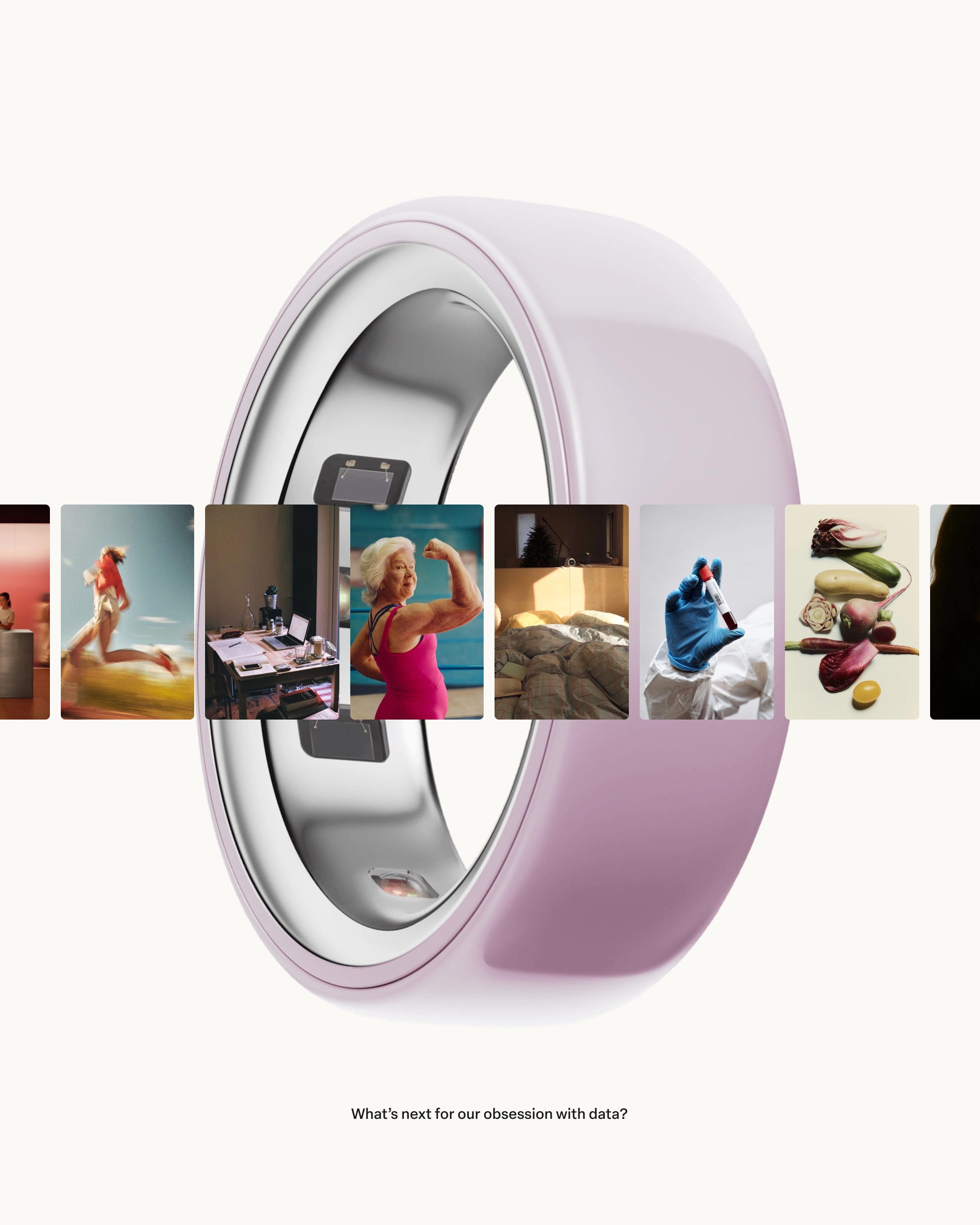
Oura. Whoop. Garmin. Suna. Ultrahuman. Lumia. Incora. Fitbit. Pulse. The wearables market is booming, and there has never been more brands or metrics to choose from when it comes to data discovery. Just three years ago, Oura was a niche predominantly worn by “business athletes” keen to hack their everyday and avoid burnout. Since then, the market has exploded globally, worth $92.9 billion in 2025 according to Grand View Research, and it’s expected to be worth $11 billion more by December 2026. The sector is growing 12 percent year on year.
Beyond is an insight and strategy company shaping the future of sport and culture. In our fieldwork around the world, we're seeing wearables become a fixture of everyday life for the everyday athlete. In this piece, we explore why the data obsession has reached a tipping point, and what brands need to do next to keep it meaningful rather than overwhelming.
Wearable technology has become a part of our everyday lives, especially amid the growth of the everyday athlete; competing for a personal best score has become a new-age status symbol. But against the backdrop of this rapid adoption and growth is increasing friction: there’s scepticism around the long-term implications of tracking our every move on our mental health. And, in an era when disconnecting from the doomscroll is becoming paramount, there’s an argument that these connected devices are keeping us more online than ever. On the other hand, wearables like Oura can highlight the direct effect of our late-night screentime with declining sleep scores—in-app tags allow users to get true visibility and take accountability. The push-pull can be challenging for brands and consumers to navigate. How best to chart this path?
The present-day infiltration
Data is driving our daily choices. Today, we track our sleep score and our heart health as easily as we can track our steps, and it’s positively influential: Oura’s readiness scores are anecdotally credited with reducing appetite for alcohol. Sleep hygiene has become a mainstream subject. Wearables have also increased our awareness of our activity levels; Garmin buzzes when a user has been static for too long, while Oura sends a push notification suggesting you “stretch your legs?” The data has been instrumental in driving awareness of the fact micro habits holistically build bigger-picture health.
As brands innovate, it’s critical they keep in mind the main missive: to empower people to become healthier.
Oura’s 2026 Year in Review synthesised the data from millions of global users to build a picture of the international cities and countries with improving health: it found New Zealand has the highest sleep score, while Europe across the whole has a higher step count.
As the sector grows, upstarts are differentiating themselves by going big on more granular data. Suna is focusing on digestive health and our gut’s microbiome—the gut is the second brain but imbalances and disorders are either difficult to identify, or take a long time to diagnose. Lumia, a wearable earring, records blood flow to the head and helps users understand mental fatigue, focus and brain fog, which is genuinely helpful in the context of our working day—it enhances our decision making, critical thinking, and response times.


The optimistic benefits of the wearables boom
Internal visibility has become one of the most valuable commodities that our money can buy. When our lives are filled with so much instability—from the economy to politics, career and financial security—our health and our bodies become the most bankable asset. We can’t control the economy, but we can better control how robust our wellbeing is; Gross Domestic Product (GDP) fails to measure true quality of life. Healthcare systems worldwide are contentious; in the UK, the NHS is crippled with waiting lists, while the soaring costs of private insurance in the US make being well a necessity, especially to those priced out of quality policies. These tools therefore have a genuine ROI that can prevent costly medical bills, if symptoms are realised earlier. If you can track it, you can manage it.
Not only does data enable us to make positive choices that impact our daily health, but personally harvested data can also arm us with information to advocate for ourselves in medical scenarios. Tests conducted on-the-day are variable as symptoms fluctuate; having daily, weekly and monthly maps provide doctors with a deeper insight as to what’s actually driving certain symptoms. AI can become a useful tool for us to gain an understanding as to what our own metrics mean; there’s an opportunity for us to utilise AI differently than simply writing LinkedIn posts.
Internal visibility is one of the most valuable commodities that our money can buy. When our lives are filled with so much instability—economic, political, professional, financial—our health and our bodies become the most bankable asset.
Appetite for knowledge means innovative body scans are also rising in demand. Swedish firm Neko Health, which has expanded to the UK and US, received a $7 billion valuation in July—a fourfold increase in the last 18 months. Within an hour, it captures data from the skin, heart, blood and metabolic health to provide a comprehensive roadmap of personal wellbeing; the aim is to diagnose potential risk before symptoms take hold. For the first time in history, we see green shoots of preventative healthcare becoming a mainstream idea; in Western medicine, care has always been reactionary.


The wearables worry: have we gone too far?
A new device called Pulse has made headlines for the fact it tracks… nothing. Instead of offering users a deep dive on their own metrics, it has replaced data harvesting with a simple buzz that reminds wearers to take a 10-second micro pause. It reportedly snaps us out of autopilot to help us to practice gratitude exercises or deep breathing to feel calm and present. It also sells itself on “no unnecessary screen time”, with “no more interruptions from stressful on-screen push notifications or alerts.” It’s an interesting framing, considering users can turn off notifications in all other wearables apps. Pulse’s concept is to sell nothing; to give visibility on nothing. Fascinatingly, that’s become the brand’s marketing play.
Perhaps our dependence on wearables has gone too far, if we need a wearable to tell us that we don’t need to wear a wearable.
Has our obsession not gone far enough?
Wearables can become more than just sleep and steps, and one way to futureproof the sector—and reframe wearables as a necessity rather than a nice-to-have amid growing tension regarding data-anxiety—could be in legitimate healthcare.
Arguably, the data currently isn’t going far enough. Could there be a wearable that helped users manage anxiety or inflammation or monitor ADHD focus levels, for example? Is there a wearable that could track the female hormone cycle to create better visibility on conditions such as PMDD? One conversation we had internally as a team recently was the future for wearables within parenthood, after one of our team posed the question, “Would you biohack your baby?” Her answer: “Yes, I would.”
Wearables enable us to become versed in the vernacular of our own bodies—and for mothers to be even more empowered in the advocacy for their babies’ health, both within the home and within the medical system. Devices better inform our longevity conversations and innovations, which ultimately turn wearables into a preventative health tool—not only for the one percent who are already biohacking, but for every person across every income level in society. Utilised this way, wearables can close the gap between lifespan and health span. The ability to live well becomes more equal—medical experts have to take personal data seriously, and not only from those on a private health insurance plan.
With increased data comes increased media attention, which could result in increased pressure on governments and healthcare systems to invest in research on women-only conditions. Neurotechnology, now in its infancy, could become more popular and give us visibility on things like our central nervous system, our metabolism or effects of glucose and certain foods on our bodies; will scientists find a way to develop a wearable that can test bodily reactions to certain foods to help identify allergies or intolerances beyond an on-the-day blood test?
Chronic inflammation is among the biggest underlying health issues that remains difficult to diagnose but the effects of which are felt everywhere. Companies could go further in their pursuit of personal data harvesting to track more and offer greater visibility on the impacts. There’s also an opportunity for more data dots to be connected.
Currently, Oura predicts a woman’s menstrual cycle, but if a period is missed there isn’t any in-app data mining that helps a woman decipher the cause; it also doesn’t send alerts about unusual cycle lengths. If a wearable is going to let us track something, we need the app to translate the findings into real-time meaning—what today’s late period could mean for tomorrow.
The education gap
Currently, wearables give us information about ourselves, but we have not been given context about how we should be engaging with these devices—what is best practice in the case of wearables, besides wearing them every day?
We are becoming versed in knowing how to engage with technology: government-enforced bans on screentime for under 16s between midnight and 6am are becoming more common, and many of us are aware that we should avoid screen time before bed. People can become obsessed with their sleep score because there’s no education around how we should engage with the information; there is no guide that says to use the information as a guide, not as gospel. Either, we need to become better educated, or devices intervene on our behalf. Only the former gives us true agency.
The demographic gap
As wearables become a more mainstream idea, brands should think mindfully about customer acquisition beyond volume. Key demographics to target right now: the silent generation and baby boomers. The silent generation, now aged between 80 and 93, are right now, the ones for whom wellness is a critical matter. Health can decline fast in older age, but as a population we are living longer than ever; positive intervention can help course correct, especially when it relates to brain optimisation versus the body. Baby boomers, currently in the early years of retirement, have the most to gain by getting a grip on their own internal systems. Their health will directly impact their quality of life for the remainder of it.
Brands within the wearables can also own longevity conversation. Today’s data is not only about enhancing for tomorrow, but future proofing for the next twenty-plus years. Gen Z, who came of age during the wellness boom, is the healthiest generation to date; this trend will continue for future generations and, as we are living longer, actually being well will become fundamental.
Wearables brands need to find a way to connect us better with our bodies while disconnecting us from smartphone-induced stress: this is the next frontier of personal tech. Healthy body; calm mind.
Future growth
The law of diffusion curve tracks how quickly innovation is adopted by a population. The five stages of people, from the very early adopters to the late adopters; only 20 percent of the population needs to adopt a new innovation in order for it to become mainstream. There is no timestamp on the curve; carbon trainers were once a professional niche that are now found on the feet of those jogging weekend 10ks.
According to a 2025 Statista report on Smartwatches Worldwide, currently 7.1 percent of the global population owns a wearable; it’s expected to hit 11.1 percent by 2031. Adoption is faster in more affluent countries.
This space is exciting not only for its rapid growth among first-world nations. We believe the real driver should be the longer-term implication on how such companies and innovations can democratize global health. Wearables can support better population health at a mass level when adoption becomes commonplace. As brands innovate, it’s critical they keep in mind the main missive: to empower people to become healthier.
Well written. The debate--apps as life coach versus apps as needless stressor--is a fun one and this essay is a strong part of it.